Sri Dharbaranyeswarar Temple (Sri Saneeswara Bhagavan Sthalam), Thirunallar
Thirunallar, Karaikal district (Puducherry UT) · Lord Shiva as Dharbaranyeswarar with Goddess Pranambika (Bhogamartha Poonmulaiyal); Lord Saneeswara (Saturn) in his own shrine
India's foremost Saturn shrine: bathe in Nala Theertham, light a sesame lamp, and ask Sani Bhagavan for mercy where King Nala was freed from him.
Thirunallar, 5 km from Karaikal, is a Chola-era Shiva temple whose shrine to Saneeswara (Lord Saturn) makes it the most important Saturn temple in South India and the Saturn stop on the Navagraha (nine-planet) pilgrimage. Legend says King Nala was released here from Saturn's affliction, and devotees suffering 'Sani dosha' come to bathe in Nala Theertham, light sesame-oil lamps and pray. Every two and a half years, when Saturn moves to a new zodiac sign (Sani Peyarchi), the town fills with lakhs of pilgrims.
Timings
- Temple open (approx.): approx. 6:00 AM – 12:30 PM and 4:00 PM – 9:00 PM (not published officially; extended on Saturdays and Sani Peyarchi – check locally)
- Pooja sessions (official): Six kalams from 6:00 AM to 9:00 PM (see schedule)
Daily rituals
- 6:00 – 7:00 AM – Usha kalam: Early-morning worship.
- 8:30 – 9:30 AM – Kalasanthi: Morning pooja.
- 11:00 AM – 12:30 PM – Uchi kalam: Noon pooja.
- 5:00 – 6:30 PM – Sayaratchai: Evening pooja.
- 7:00 – 8:00 PM – Irandam kalam: Night pooja.
- 8:30 – 9:00 PM – Arthajamam: Last pooja of the day. Each kalam includes abhishekam, alankaram, naivedyam and deeparadhanai for Shiva and the goddess; Saturn has five poojas a day.
Darshan types and costs
- General darshan – Free. Long queues on Saturdays, especially in the Tamil month of Purattasi, and very long around Sani Peyarchi.
- Paid special darshan – Varies (check official site). Paid queues and online darshan booking exist (e-Seva on the temple website); third-party sites quote ₹100–₹150 but this was not confirmed.
Sevas and costs at Sri Dharbaranyeswarar Temple (Sri Saneeswara Bhagavan Sthalam), Thirunallar
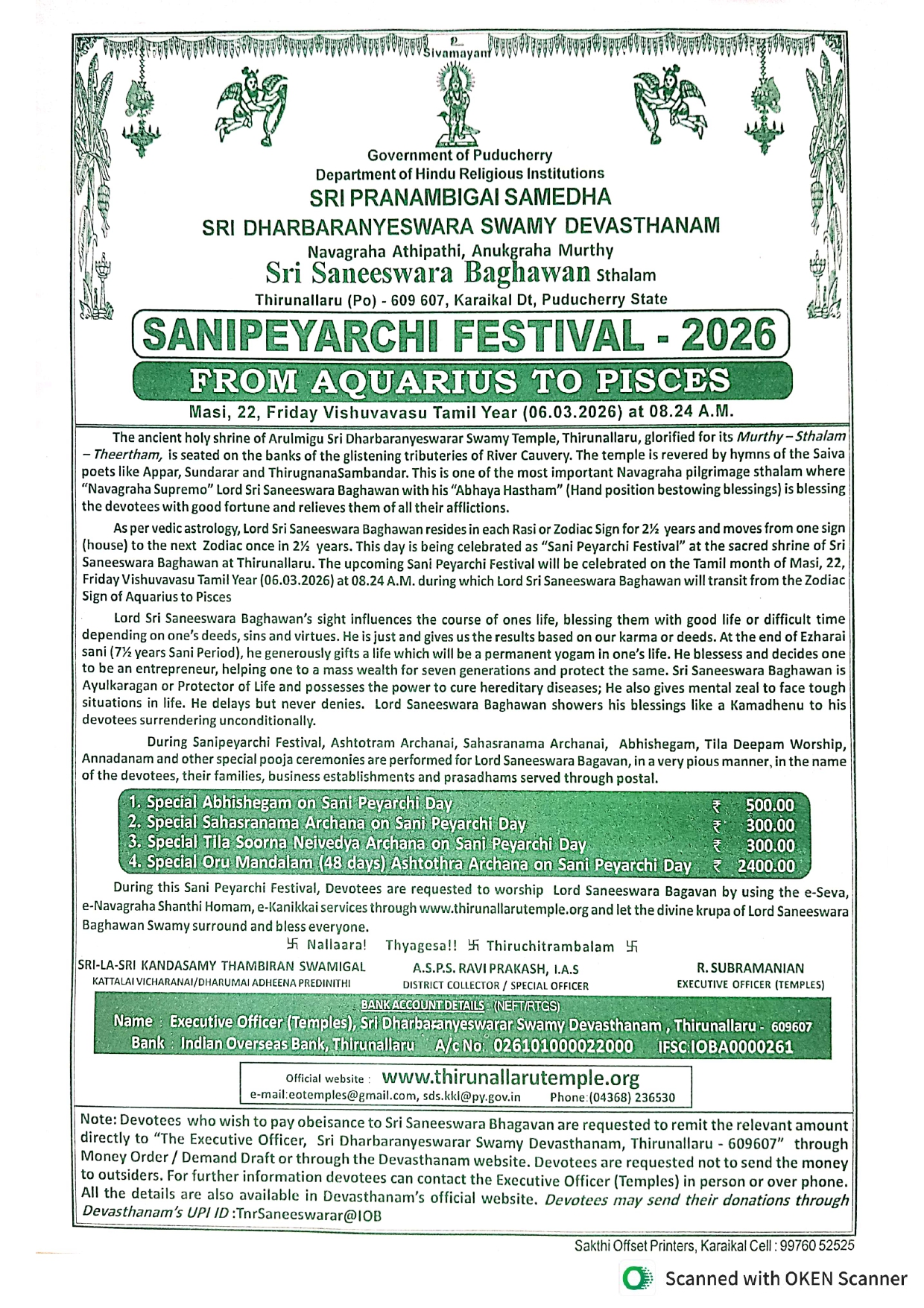
Special Abhishekam on Sani Peyarchi day – ₹500
When: Sani Peyarchi day (last: 6 March 2026)
Abhishekam for Saneeswara performed in your name; prasadam sent by post.
How to book: Through the temple e-Seva site, by money order / demand draft to the Executive Officer, or at the office.
Price from the temple's 2026 Sani Peyarchi notice.
Special Sahasranama Archana on Sani Peyarchi day – ₹300
When: Sani Peyarchi day
Chanting of Saturn's thousand names in your name and star.
How to book: e-Seva / postal remittance / office.
Special Tila Soorna Naivedya Archana on Sani Peyarchi day – ₹300
When: Sani Peyarchi day
Archana with an offering of sesame-powder naivedyam, Saturn's favourite.
How to book: e-Seva / postal remittance / office.
Oru Mandalam (48-day) Ashtothra Archana – ₹2,400
When: 48 days from Sani Peyarchi
Daily 108-name archana in your name for a full mandalam.
How to book: e-Seva / postal remittance / office.
Postal Archana – Check official site
When: Any day
Archana in your name; prasadam posted to you.
How to book: Online via e-Seva or by money order / DD in favour of the Executive Officer (Temples), Thirunallar – 609 607, writing name, address and birth star in block letters.
Navagraha Shanti Homam (e-Homam) – Check official site
When: On booking
Fire ritual to pacify the planets, done by temple priests.
How to book: e-Seva (homam booking).
Sesame (ellu) lamp – Small fee for the lamp
When: Daily, especially Saturdays
Devotees light lamps fed with gingelly (sesame) oil before Saneeswara; the temple says this lessens Saturn's harshness.
How to book: Buy at the temple stalls.
How to book darshan
Darshan, postal archana, homam, sahasranama, annadhanam, accommodation and e-hundi are booked on the temple's e-Seva portal (login required). You can also remit by money order or demand draft to the Executive Officer (Temples), Thirunallar – 609 607, or pay at the office.
- Open the e-Seva page on thirunallarutemple.org and register / log in.
- Choose the service: Darshan Booking, Postal Archana, Homam, Sahasranama, Annadhanam or Accommodation.
- Enter the name, address, birth star (nakshatra) and date, and pay online.
- For postal remittances, write name, address and birth star in block letters; keep the code number printed on prasadam covers for future changes.
- The temple warns devotees to pay only the Devasthanam directly, not middlemen.
Booking safely
- Book online darshan, archana and rooms only through the e-Seva portal on thirunallarutemple.org. Third-party sites quoting darshan prices are not official.
Reach e-Seva from thirunallarutemple.org and carry your booking confirmation.
Prasadam and offerings
- Archana prasadam (vibhuti, kumkum) – With archana. Sent by post for postal bookings.
- Sesame rice – Check locally. Cooked rice mixed with sesame is Saturn's favourite naivedyam.
- Oil bath in Nala Theertham: Pilgrims apply gingelly oil, bathe in Nala Theertham and then go for darshan; traditionally they wear black.
- Sesame-oil lamp and black kuvalai flower: The temple says that bathing in Nala Theertham, lighting a sesame lamp and offering the dark kuvalai (blue water-lily) flower to Saneeswara removes all troubles.
Dress code
Traditional dress preferred (dhoti or trousers with shirt for men; saree, salwar or long skirt for women). Many devotees wear black or dark blue, Saturn's colours.
Temple etiquette
- Worship Saneeswara first and then go in to Lord Dharbaranyeswarar, as the temple tradition prescribes.
- Bathe or at least wash at Nala Theertham before darshan if you can.
- Pay only official counters or the e-Seva portal; the temple warns against sending money to outsiders.
- Photography inside the shrines is not allowed.
Why it matters
In Hindu astrology Saturn (Sani) spends about two and a half years in each sign; periods such as 'Ezharai Sani' (the 7½-year transit), Ashtama Sani and Janma Sani are believed to bring hardship. Thirunallar is the classic 'parihara sthalam' (place of remedy) for these: the temple says that whatever the affliction, worship here brings relief.
The main deity is Shiva as Dharbaranyeswarar, 'Lord of the darbha-grass forest', believed to be self-manifested (swayambu) and still to bear the marks of the darbha grass. Saturn's shrine stands at the entrance of the inner sanctum, as a doorkeeper, and the tradition is to worship Saturn before going in to Shiva.
The temple is a Paadal Petra Sthalam, one of the 275 Shiva temples praised in the Tevaram hymns by Sambandar, Appar and Sundarar. Sambandar's hymn beginning 'Bhogamartha poonmulaiyal' is called the 'pachai padhigam' (green hymn) because, by tradition, the palm leaf it was written on did not burn in his fire-contest with the Jains; the temple recommends singing it to remove Saturn's afflictions.
Thirunallar is also one of the seven Saptha Vidanga sthalams, linked to the Thyagaraja cult of Tiruvarur, where the festival image of Thyagaraja is carried in a special 'dancing' procession.
Legends
King Nala and Saturn
Nala, king of Nishadha, married Damayanti, who chose him over the gods. The angered gods had Saturn test him: Nala lost his kingdom, his wealth and even his wife, and lived as a servant. At last he came to Darbaranyam, bathed in the tank and worshipped Shiva here, and Saturn released him. Nala regained everything and asked Shiva to protect all devotees afflicted by Saturn who come here. The tank he bathed in is Nala Theertham.
The shepherd and the bali peetham
A king ordered a shepherd to supply milk for the deity's daily bath, but the local headman forced the shepherd to give him the milk instead. When the king sentenced the silent shepherd to death, Shiva stopped the punishment with his trident. In memory of this, the temple's bali peetham (offering altar) stands slightly off the line of the flagstaff and sanctum.
The green hymn
During Sambandar's contest with the Jains, the palm-leaf hymns were thrown into fire; the leaf with the Thirunallar hymn came out green and unburnt. It is still sung by devotees seeking relief from Saturn.
History
Legendary: Darbaranyam
The site is described as a forest of darbha grass where Shiva appeared as a self-made linga; Vishnu, Brahma, Indra, Agastya, Arjuna and Nala are said to have worshipped here.
7th century: Sambandar and Appar
Tirugnana Sambandar sang hymns here (the temple counts four), and his contemporary Appar sang ten verses included in the Fifth Tirumurai.
9th century: Sundarar's hymns
Sundarar also praised the temple, completing the Tevaram trio.
9th century: Chola masonry temple
The present stone structure was built under the Chola dynasty.
15th century: Arunagirinathar
The Murugan poet Arunagirinathar visited and sang verses later included in the Thiruppugazh.
Vijayanagara period: Expansion
Later expansions are attributed to Vijayanagara rulers.
French era: Karaikal enclave
Thirunallar lay within the French territory of Karaikal and passed to India with Puducherry; it is now run by the Puducherry government's Hindu Religious Institutions department.
6 Mar 2026: Latest Sani Peyarchi
Per the temple's notice, Saturn's transit from Aquarius to Pisces was celebrated on Masi 22 (Friday, 6 March 2026) at 8:24 AM.
Architecture
The temple covers about 2 acres and is entered through a five-tier rajagopuram adorned with stucco figures. All the shrines are enclosed within concentric rectangular granite walls.
The main sanctum, on a raised platform in line with the entrance, holds Dharbaranyeswarar as a linga. A parallel shrine to the south houses Somaskanda (Shiva with Parvati and the child Murugan), and the niches around the sanctum hold Dakshinamurthy, Durga and Lingodbhava.
Saneeswara stands in a niche facing east on the north side, just at the entrance to Shiva's sanctum, in an 'anugraha' (blessing) pose with his hand raised. The southern corridor has images of the 63 Nayanmars, with a separate shrine to King Nala at the end of the gallery.
The temple has several sacred tanks: Brahma, Vani, Hamsa, Agastya and, most famous, Nala Theertham. The sthala vriksham (sacred tree) is the darbha (kusa) grass.
What to see
- Saneeswara shrine: Saturn in a gracious standing pose, his raised hand in blessing; worshipped before going in to Shiva.
- Nala Theertham: The tank where Nala is said to have bathed; devotees take an oil bath and dip here before darshan.
- Nala shrine: A separate shrine to King Nala at the end of the Nayanmar gallery in the southern corridor.
- Thyagaraja (Nagavidangar): One of the seven Vidanga images of the Tiruvarur Thyagaraja tradition, processed in a distinctive swaying 'dance'.
- Off-centre bali peetham: The altar deliberately set off-axis, recalling the shepherd legend.
How to cover the temple
The documented tradition is to bathe in Nala Theertham with oil, light a sesame lamp, worship Saneeswara at the entrance of Shiva's sanctum first, and only then go in to Lord Dharbaranyeswarar and the goddess. Allow half a day; much longer on Saturdays and Sani Peyarchi.
- Nala Theertham: Apply gingelly (sesame) oil, bathe or dip in Nala Theertham, where King Nala is believed to have bathed, and change into clean clothes; many wear black.
- Sesame-oil lamp: Buy and light a lamp fed with gingelly oil; the temple says this lessens Saturn's harshness.
- Five-tier rajagopuram: Enter through the main gopuram into the outer corridor.
- Saneeswara shrine: Saneeswara stands at the entrance to Shiva's sanctum as its doorkeeper; tradition is to worship him first. Offer the dark kuvalai flower if you have it.
- Dharbaranyeswarar and Pranambika: Darshan of the self-manifested linga, then of the goddess Pranambika (Bhogamartha Poonmulaiyal).
- Nayanmars and Nala's shrine: Walk the corridor past Kalathinathar and Karpaka Vinayakar and the gallery of the 63 Nayanmars to King Nala's shrine at its end (usual route).
- Vidanga Thyagaraja and the bali peetham: Note the off-centre bali peetham on the way out, linked to the shepherd legend.
Customs and traditions
Oil bath in Nala Theertham
An oil bath and dip in the temple tank before worship, often in black clothes.
Nala was freed from Saturn's affliction after bathing here and worshipping Shiva.
At Nala Theertham near the temple, early morning is best; free.
Ellu (sesame) deepam
Lighting lamps fed with sesame oil before Saneeswara, especially on Saturdays.
Sesame is Saturn's favourite; the temple says such lamps reduce the intensity of Saturn's effects.
Lamps and oil are sold at the temple; light them at the place shown by staff.
Sani Peyarchi worship
Special abhishekam and archanas on the day Saturn changes sign, every ~2.5 years.
Saturn's transit affects people differently by birth sign; worship on that day is believed to ease difficult periods such as Ezharai Sani.
Book via e-Seva or the office; 2026 rates were ₹500 (abhishekam), ₹300 (sahasranama or tila soorna archana) and ₹2,400 (48-day archana).
For elders and differently-abled visitors
Access: Moderate. The temple is on level ground, but Saturdays draw very large crowds. Choose a weekday if you can.
- No separate senior queue found. The temple e-Seva portal lists paid and online darshan; check the portal for current categories.
- No separate queue found. Ask the temple office.
Waiting time
Long queues on Saturdays, especially in Purattasi (as per the existing guide). A 2018 Puducherry police profile says about 50,000 people visit on Saturdays.
Saturdays, and very heavy around Sani Peyarchi. Weekdays are quiet.
Best time to visit
Weekdays outside Purattasi Saturdays. October–February is cooler. Sani Peyarchi days and Saturdays draw the biggest crowds.
Festivals
Sani Peyarchi (Saturn transit) (Every ~2.5 years (last on 6 March 2026, Aquarius to Pisces))
The temple's greatest event: continuous abhishekam, archana and naivedyam all day; lakhs of pilgrims.
Brahmotsavam (Vaikasi (May–June), 18 days from Uthiratadhi star)
Ends with the 'Lord giving darshan to the shepherd' episode.
Purattasi Saturdays (September–October)
Saturdays in Purattasi are especially crowded for Saturn worship; Purattasi full-moon pujas for the emerald linga.
Maha Shivaratri (February/March)
Night-long Shiva worship.
Tamil New Year (14 April)
Thyagaraja procession.
Navaratri, Karthigai Deepam, Panguni Uttiram (Through the year)
Celebrated with special poojas.
How to reach Sri Dharbaranyeswarar Temple (Sri Saneeswara Bhagavan Sthalam), Thirunallar
- By air: Tiruchirappalli airport is the nearest commercial airport, approx. 150 km; Chennai is approx. 300 km.
- By rail: Karaikal railway station is about 5 km away; Nagapattinam and Mayiladuthurai are other railheads.
- By road: Thirunallar is about 5 km from Karaikal town and about 95 km from Thanjavur; Karaikal is linked to Puducherry (approx. 135 km) and Chennai by the East Coast Road. Town buses and autos run from Karaikal.
Road safety
Flat delta roads from Karaikal (5 km), Nagapattinam or Mayiladuthurai make this an easy drive most days, but Saturdays and especially Sani Peyarchi turn the small town into a massive traffic jam. Arrive early or come by bus on festival days.
Two-lane road from Karaikal through the Cauvery delta into a small temple town; narrow streets around the temple and Nala Theertham. Parking is limited and fills early on Saturdays.
Where to stay
The Devasthanam runs accommodation bookable through its e-Seva portal; Karaikal town (5 km) has more hotels.
- Devasthanam rooms, Thirunallar – Check official site. Book via the e-Seva portal (Accommodation).
- Hotels in Karaikal – Varies. Book online.
Suggested plan
Half day
- Arrive early; oil bath and dip in Nala Theertham.
- Light a sesame lamp and worship Saneeswara at the entrance shrine.
- Darshan of Dharbaranyeswarar and Pranambika; walk the corridor past the 63 Nayanmars to Nala's shrine.
- Visit Karaikal Ammaiyar temple on the way back.
Tips
- Avoid Saturdays and the days around Sani Peyarchi unless you want the festival atmosphere; queues can last hours.
- Carry a change of clothes if you plan to bathe in Nala Theertham.
- Sesame oil, lamps and black cloth are sold near the temple.
- Combine with the Navagraha circuit around Kumbakonam.
Frequently asked questions
When is the next Sani Peyarchi?
The last was on 6 March 2026 (Aquarius to Pisces). The next transit is about 2½ years later; the temple announces the exact date and time.
What should I do for Ezharai Sani or Ashtama Sani?
The temple's tradition: bathe in Nala Theertham, light a sesame lamp, offer the kuvalai flower to Saneeswara and worship Shiva; many also book an archana or Navagraha homam.
Do I worship Saturn or Shiva first?
Saturn first. His shrine is at the entrance of Shiva's sanctum and he is treated as its doorkeeper.
Can I book archana without visiting?
Yes, postal archana via the e-Seva portal or by money order / DD to the Executive Officer (Temples), Thirunallar – 609 607.
What were the Sani Peyarchi 2026 seva prices?
Special abhishekam ₹500, sahasranama archana ₹300, tila soorna naivedya archana ₹300, and 48-day ashtothra archana ₹2,400 (temple notice).
Is Thirunallar in Tamil Nadu?
No. It is in Karaikal district of the Union Territory of Puducherry, though surrounded by Tamil Nadu.
Temples nearby
- Suryanar Kovil and the Navagraha Temples of Kumbakonam – Suryanar Kovil village near Aduthurai, and around Kumbakonam (Thanjavur, Mayiladuthurai and Thiruvarur districts, plus Karaikal) (about 45 km by road)
- Vaidyanathaswamy Temple, Vaitheeswaran Koil – Vaitheeswaran Koil, between Chidambaram and Sirkazhi, Mayiladuthurai district (about 46 km by road)
- Arulmigu Thyagarajaswamy Temple, Tiruvarur – Kamalalayam Tank, Thiruvarur town, Tiruvarur district (about 48 km by road)
- Arulmigu Swaminatha Swamy Temple, Swamimalai – Swamimalai, near Kumbakonam, Thanjavur district (about 61 km by road)
- Thillai Nataraja Temple, Chidambaram – Chidambaram, Cuddalore district (about 69 km by road)
- Arulmigu Peruvudaiyar (Brihadeeswarar) Temple – Thanjavur, Thanjavur district (about 106 km by road)
More Shiva temples
- Sri Bhramaramba Mallikarjuna Swamy Varla Devasthanam – Srisailam, Nandyal district
- Ramappa (Rudreswara) Temple, Palampet – Palampet, Venkatapur mandal, Mulugu district
- Arulmigu Ramanathaswamy Temple – Rameswaram island, Ramanathapuram district
- Sri Virupaksha Temple, Hampi – Hampi Bazaar, Hampi, Vijayanagara district (formerly Ballari)
- Arulmigu Ekambareswarar Temple (Ekambaranathar Temple) – Periya Kanchipuram, Kanchipuram district
- Arulmigu Jambukeswarar Akilandeswari Temple, Thiruvanaikaval – Thiruvanaikaval, Tiruchirappalli (Trichy), on Srirangam island between the Kaveri and Kollidam rivers
Managed by
Official website: thirunallarutemple.org
Sources
- Temple website – home (legend, contact, postal remittance)
- Temple website – pooja schedule
- Temple website – festivals
- Temple website – holy tank and deities
- Temple website – history
- Temple notice – Sanipeyarchi Festival 2026 (prices)
- Wikipedia – Thirunallar Dharbaranyeswarar Temple
Last checked: 2026-10. Timings and fees change – confirm with the temple before you travel.